Capsule Endoscopy (NaviCam Small Bowel with AI ProScan)

Capsule endoscopy (video capsule endoscopy) lets us see the lining of the small intestine, which is hard to reach with standard endoscopes and hard to see on X-rays or CT scans. You swallow a capsule about the size of a large vitamin. As it travels through your digestive tract, a tiny camera inside takes thousands of pictures and sends them to a recorder you wear.
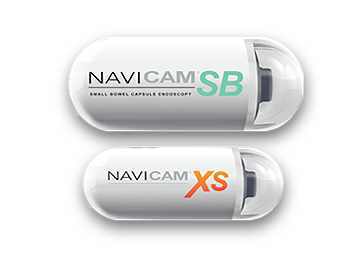
NaviCam Small Bowel with ProScan
Our office uses the NaviCam SB (Small Bowel) Capsule System by AnX Robotica. It uses ProScan, an artificial intelligence (AI) system that helps read the images and improves reading accuracy. ProScan flags pictures that may show an abnormality so our physicians can review them closely. In a large study published in Gastroenterology (Ding et al., 2019), AI-assisted reading found abnormalities with about 99.9% sensitivity, compared with about 75% for conventional reading, and cut reading time substantially. Your physician reviews every finding.

Why capsule endoscopy is done
- Hidden bleeding or iron-deficiency anemia after a normal upper endoscopy and colonoscopy. This is the most common reason.
- Diagnosing or checking Crohn's disease of the small intestine
- Small-bowel polyps, tumors, and inherited polyp syndromes
- Ulcers or damage from NSAIDs
- Complications of celiac disease
If the capsule finds something that needs a biopsy or treatment, we may recommend small bowel enteroscopy.
How to prepare
When you schedule your test, tell us about:
- All medicines and allergies, especially iron pills, which may need to be stopped a few days before
- Diabetes, heart or lung problems, or bleeding problems
- Implanted devices, such as a pacemaker or defibrillator
- Past bowel surgery, radiation, Crohn's disease, or swallowing problems
On the day before and the day of the test:
- Do not eat or drink for 10 hours before the test.
- Your doctor may prescribe a bowel prep to clear the intestine for better pictures.
- Do not take any medicine in the 2 hours before the test.
- Wear loose, two-piece clothing so the recorder belt fits comfortably.
What to expect
- You swallow the capsule with water in our office, and a recorder is attached with a belt.
- Unless told otherwise, you may have clear liquids 2 hours after swallowing the capsule, a light snack after 4 hours, and a normal meal after 8 hours.
- Go about your day, but avoid strenuous exercise and bending. Light activity is fine.
- A light on the recorder blinks while it records. Check it after bowel movements, and call us if it stops blinking.
- Stay away from strong magnetic fields, such as MRI machines.
- After 12 to 24 hours, return the recorder to our office so we can download the pictures.
If you cannot swallow the capsule, or your stomach empties slowly, the doctor can place it in the small intestine during an upper endoscopy.
After the test
The capsule passes naturally in a bowel movement, usually within a day or two. You don't need to retrieve it, and it is fine if you don't see it. We review the video and contact you with results in a few days. If the video shows the capsule did not reach the colon, we may order an X-ray after 2 weeks to make sure it has passed. Do not have an MRI until you are sure the capsule has passed.
Risks
Capsule endoscopy is very safe. The main risk, which is rare, is the capsule getting stuck in a narrowed part of the bowel, most often in people with Crohn's disease, past bowel surgery, or radiation. If we suspect narrowing, we may first give you a dissolvable "patency" capsule to make sure the real capsule can pass. A stuck capsule can usually be removed with enteroscopy; surgery is rarely needed. Call us for belly pain, vomiting, or bloating after the test.
Make an appointment
Our gastroenterologists in Temple City care for patients from Arcadia, San Gabriel, Pasadena, Monrovia, Monterey Park, and across the San Gabriel Valley. We accept most PPO plans (see accepted insurances), and our doctors speak English, Vietnamese, and Mandarin. Schedule an appointment or call 626-898-4560.
This article is for general education and is not a substitute for medical advice. Talk with your doctor about your own health.
Quick Answers
What is capsule endoscopy?
A test in which you swallow a vitamin-sized capsule with a tiny camera. It takes thousands of pictures of the small intestine as it moves through, and they are sent to a recorder you wear.
Which capsule do you use?
The NaviCam SB Capsule System by AnX Robotica. Its ProScan artificial intelligence helps our physicians read the images more accurately and find abnormal areas.
Why is capsule endoscopy done?
Most often to find the source of bleeding or iron-deficiency anemia after a normal upper endoscopy and colonoscopy. It also checks for Crohn's disease, polyps, tumors, and celiac disease complications.
Do I have to retrieve the capsule?
No. It is disposable and passes naturally in a bowel movement, usually within a day or two. Avoid MRI until you are sure it has passed.
Can the capsule get stuck?
Rarely, usually in people with a narrowed bowel from Crohn's disease, past surgery, or radiation. If we suspect narrowing, we may give you a dissolvable test capsule first.